
2025 Ependymoma Awareness Day Outreach Report
— Categories: Posted on December 11, 2025
In a groundswell of international support, patients, care partners, medical professionals, and advocates participated in a variety of events marking June 10, 2025, as Ependymoma Awareness Day.
The CERN Foundation, a program at National Brain Tumor Society, hosted a virtual webinar featuring speakers from the patient and professional community on the topics of second opinions and biomarker testing. The webinar included community polls and announced a new award to recognize community members. The event concluded with a pre-recorded butterfly release as a way to honor loved ones with ependymoma, recognize care partners and medical workers, and to support ependymoma research efforts.
Webinar Highlights
Over 250 community members registered to participate in the Ependymoma Awareness Day webinar. Here is a snap shot of the diverse community:
3% Foundations
4% Researchers
18% Care Partners - Including Friends, Grandparents, Aunts, and Uncles
35% Ependymoma Survivors
39% Ependymoma Parents
The 2025 Ependymoma Awareness Day Virtual webinar was truly an international event. The majority of the registrants (70%) were from the United States followed by the remaining 30% from Australia, Germany, Austria, Canada, Ireland, Italy, New Zealand, South Africa, Serbia, Mexico, Slovakia, Belgium, Sweden, Netherlands, Venezuela, Spain, Montenegro, Jordan, North Macedonia and Israel.
During the webinar, there were two optional community polls for participants to engage in. Here are the results from this effort.
Have you or your loved one ever received a second opinion at any point during your experience with ependymoma?
66% Yes
32% No
2% Unsure
Do you know your or your loved one’s ependymoma subtype?
26% Supratentorial ZFTA/RELA
23% Spinal Ependymoma
19% Posterior Fossa A (PFA)
16% Don’t know
5% Posterior Fossa Ependymoma
5% Myxopapillary Ependymoma (MPE)
2% Supratentorial YAP fusion
2% Other
2025 Ependymoma Awareness Day Speakers
Megan and Mike Patterson share their personal journey and the importance of seeking second opinions after Megan's diagnosis with High MYCN Anaplastic Ependymoma (WHO grade III). Megan talks about the importance of getting a second opinion both before and after treatment that helped to collect information and validate her decisions. In addition, she was able to address conversations about related issues like fertility family planning, cognitive changes that could impact her career, access to specialists in fertility and cognition, and emphasized the importance of talking with experts about life changing decisions. Also, finding a community to get input from through support groups, both local and virtual, after treatment was meaningful to her. As Megan shares, “Five years following my diagnosis, I am still seeking second opinions from them (support groups) on how to navigate rough days and odd situations that come about because of what we have gone through.”
Megan describes her slow progression to seeking medical help for increasing pain. After an MRI in April 2020, a tumor was discovered in her spinal column. She sought multiple opinions for surgery, considering orthopedic surgeons and neurosurgeons. All opinions initially suggested a benign schwannoma, but the biopsy revealed it was ependymoma, a form of cancer. She emphasizes the importance of seeking second opinions and how that extends beyond initial treatment plans, and can include other questions like family planning and cognitive changes. They chose MD Anderson Cancer Center for treatment due to access to specialists in fertility and cognition, which helped them make crucial life-changing decisions. For their family, community support was extremely meaningful and continues to be of great value to them.
Mike shares his perspective as a caregiver and recalls moments from Megan's recovery in the ICU to when they received the tumor results. He quickly learned that no single provider knows everything, which reinforced the need to expand their care team and support network for multiple trusted opinions. Mike recounts reaching out to the CERN program at NBTS and the impact it made on their journey. This connection provided a significant shift in his confidence and feeling of control during a stressful time. CERN helped them understand the disease, recommended hospitals and providers, and supported their choices in navigating a rare disease. He concludes by stating that a second or third opinion doesn't always have to be a different course of action, but can confirm you're doing the best you can.
Dr. Hadjipanayis discusses the important aspects of navigating a brain or spine tumor diagnosis, particularly ependymoma. He emphasizes the challenging nature of such diagnoses and the importance of seeking second and even third opinions.
Dr. Hadjipanayis also highlights the significance of receiving care from multi-disciplinary teams at expert centers. He shares "You should definitely get a second opinion. If you feel like you should get a third opinion, please do that. And in fact, I tell my patients, any provider who is uncomfortable with you getting a second opinion, you shouldn't be seeing that person." For ependymoma specifically, he stresses the neurosurgeon's role in safely removing as much of the tumor as possible while preserving neurological function. He mentions the crucial role of imaging before surgery and tumor testing afterwards to understand how the tumor might behave and respond to treatments.
Daniel Godsil shares the story of his young daughter, Betsy, and her journey with ependymoma. In February 2024, Betsy, then 6, began displaying concerning symptoms like vomiting, lethargy, clumsiness, and balance issues. Particularly alarming were her headaches, which she described as her "forehead hurting", and a sudden inward turning of her right eye. After a pediatrician's concern, Betsy underwent a CAT scan, followed by an MRI, and then surgery to remove a plum-sized tumor from her right frontal lobe. Post-surgery, her left side was immobile, leading to physical therapy.
The family, despite having many members in the medical field, found communication with the medical team challenging and felt their questions were often unaddressed. What felt like eternity, the pathology report took nearly four weeks, confirming the tumor was ependymoma grade three and that radiation was recommended. It was also suggested that Betsy have a second pass surgery to try and remove as much as possible. Daniel felt the initial advice about chemotherapy was unclear, which caused uncertainty for his family highlighting the need for more information on this topic. The CERN program at the National Brain Tumor Society provided personalized support through second opinion information and educational resources. Daniel shares “"The whole second opinion thing was rather confusing, which is one of the reasons why I really enjoy having CERN as a resource." Currently, Betsy is thriving almost a year after radiation treatments and is a bright light to everyone she knows. She has a new care team at UCSF and undergoes MRIs every three months. Daniel expresses a personal desire for more guidance on nutritional best practices for his daughter, noting a significant need for such information within the cancer community that he feels is often overlooked by medical professionals.
Dr. Filbin shares her expertise on the importance of thorough tumor testing for ependymoma, which can provide insights into diagnosis, prognosis, and potentially impact treatment decisions. She also discusses the progress in understanding and treating ependymoma, a rare type of brain or spinal cord tumor. For many years, ependymoma was diagnosed by looking at tissue under a microscope and classifying it by its location in the brain or spine. Significant progress has been made in the last 10-15 years, particularly with the discovery of fusions as drivers for some ependymomas. About 10 years ago, a new technology called methylation classification emerged, allowing for more precise classification of ependymomas. Dr. Filbin shares “Even though we might not know all the answers to all the questions we have, classification and giving the tumors a name is the first step in understanding where they come from and what they need to thrive and how we can block that in our best treatment going forward.”
Additionally, ependymoma requires a multidisciplinary approach to care. Effective treatment involves a team of doctors (neurosurgeon, neuro-oncologist, neuro-pathologist, etc.) working together in a multidisciplinary manner through tumor boards to discuss patient cases and formulate treatment plans. Dr. Filbin talks about the future for treatments and how there will be customized clinical trials to the distinct subgroups. While current classification mainly aids diagnosis and prognosis, it will increasingly guide enrollment in specific clinical trials tailored to tumor subtypes. For example, there is a subtype called ZFTA-RELA Fusion that was just further refined three years ago. There is an international effort to share samples to learn more about how the disease behaves and those findings will be published soon. She emphasizes that collaborative efforts and sharing information are the keys to advancing the field forward.
Emily Meyer is from a small town in Indiana. She was diagnosed with a grade 2 ependymoma when she was eighteen years old and went through a long surgery and experienced a lengthy recovery. Emily has overcome many hurdles and hopes to inspire people with her story. She recounts the sudden onset of severe balance issues and weakness that led to her emergency room visit and subsequent diagnosis of a large tumor extending from her brain stem to T5. Emily details her journey to Chicago Northwestern for treatment, where doctors were surprised by the size of her tumor. She underwent a challenging 19-hour surgery, after which she was temporarily paralyzed from the waist down and had to relearn basic tasks. Despite the difficulties, her recovery impressed everyone around her. Now 20 and almost two years tumor-free, Emily discusses the lasting impacts of her surgery, including loss of sensation in her hands and arms, and dexterity issues, which have affected her independence. Emily emphasizes the significance of having a strong support system and advises newly diagnosed individuals to allow themselves to feel all emotions. She concludes by stressing the importance of raising awareness, not taking life for granted, and living life to the fullest.
CERN Community Award
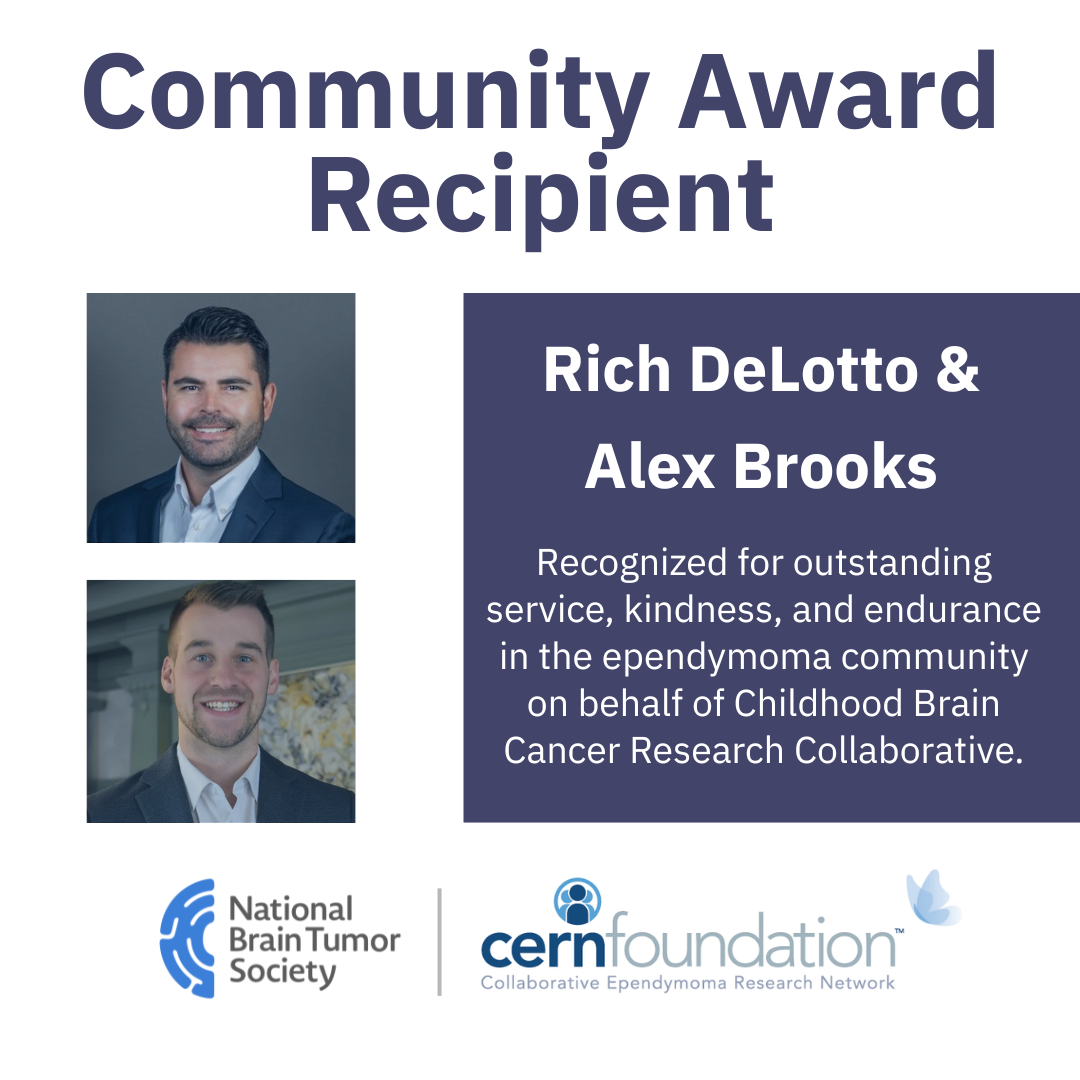 Community is essential with a brain or spine tumor diagnosis like ependymoma. Many community members dedicate time and attention to supporting others in addition to caring for themselves or a loved one. Because of this, the Community Award was created to recognize outstanding members who go above and beyond to help others. The recipient is selected based on outstanding service, kindness, and endurance in the ependymoma community. The 2025 Ependymoma Community Award goes to Rich DeLotto and Alex Brooks on behalf of the entire Childhood Brain Cancer Research Collaborative. Rich got involved because he is the father of an ependymoma survivor and Alex is a true team leader and adopted the cause as his own. In addition to preparing for their 7th annual golf outing, Rich and Alex recognized the importance of supporting education initiatives by sponsoring the Ependymoma Guide. They also recognized the ongoing need for critical research commitments and took action to help NBTS fuel translational discovery for pediatric ependymoma by contributing proceeds from their events to the ependymoma fund over many years. Thank you Rich, Alex, Kara and the entire CBCRC team for your unwavering dedication to this cause.