
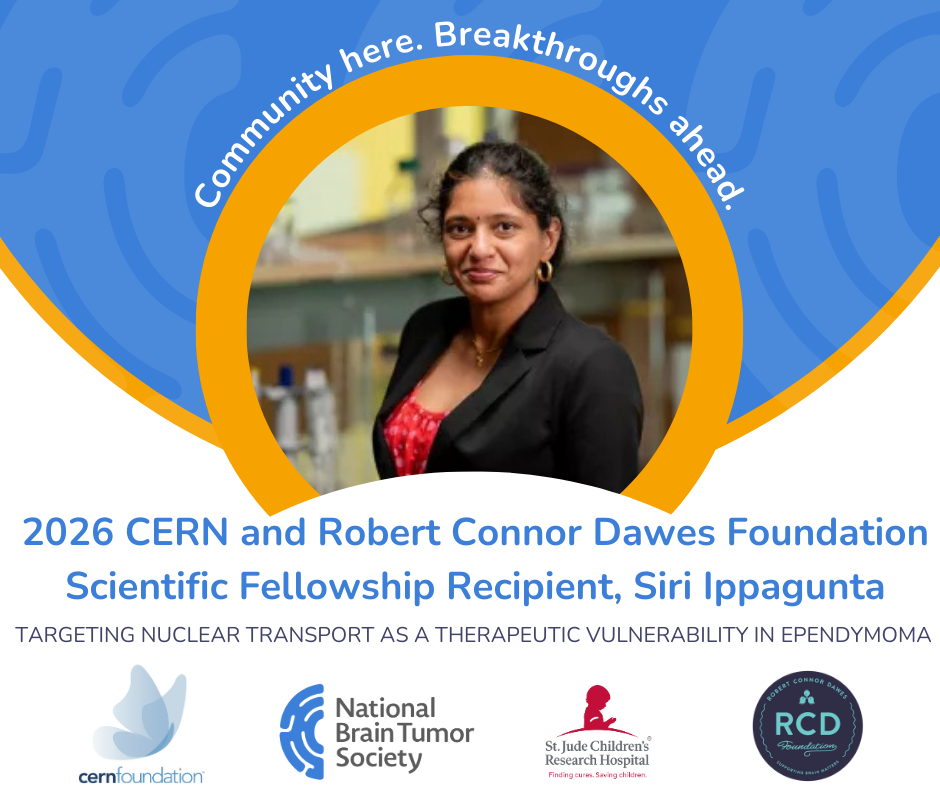
Congratulations to Siri Ippagunta, recipient of the 2026 CERN and Robert Connor Dawes Scientific Fellowship awarded by the National Brain Tumor Society!
— Categories: CERN Research Articles Press Release Posted on January 26, 2026
Dr. Siri Ippagunta, from the Mack Lab at St. Jude Children’s Research Hospital in Memphis, TN, is the recipient of the 2026 CERN and Robert Connor Dawes Scientific Fellowship awarded by the National Brain Tumor Society. Her research efforts, under the leadership of Dr. Stephen Mack, will focus on Targeting Nuclear Transport as a Therapeutic Vulnerability in Ependymoma. This prestigious honor kicks off the 20th Anniversary year of CERN, and perfectly highlights the program’s commitment and dedication to global ependymoma research and advocacy.
 Brain cancer is the number one cause of disease-related death in children. One type of brain and spine tumor, called ependymoma (EPN), is especially challenging to treat. For more than 30 years, children with ependymoma have had to rely on the same treatments — surgery and radiation — and sadly, many tumors come back even after this aggressive care.
New, more effective treatments are urgently needed.
A key challenge for clinicians and researchers looking to develop better medicines for ependymoma - is that there are a variety of different subtypes of this tumor, which have different behaviors, prognoses and outcomes. The focus of this research project will be on a specific form of ependymoma called ZFTA-RELA (ZR) driven-ependymoma, or “ZR-ependymoma.”
To study ZR-ependymoma, the team at St. Jude Children’s Research Hospital created one of the first genetic mouse models of this type of ependymoma. This new mouse model will help researchers study how the cancer starts and allow them to test new treatments in the laboratory setting.
Support from the NBTS has enabled the Mack Lab to leverage this model for pre-clinical studies prioritizing new drugs and drug combinations that could have potential to translate to patients with ependymoma.
Through research conducted in the Mack Lab, it was discovered that ZFTA-RELA ependymoma cancer cells rely on a protein called Exportin 1 (XPO1) to stay alive. When the protein is blocked, the tumor cells die. This finding led the team to test a drug called Selinexor, an FDA-approved cancer medication, which can get into the brain and safely block XPO1. Excitingly, Selinexor worked well against ependymoma cells when evaluated in the lab using mouse models, shrinking the tumors and improving survival of the mice. Additionally, it was discovered that combining Selinexor with other drugs already tested in children with ependymoma — such as Gemcitabine and Ribociclib — made the treatment even more effective. Based on these promising results, the team believes that blocking nuclear export — the process that XPO1 controls — could be a powerful new treatment strategy for children with this form of ependymoma.
Dr. Siri Ippagunta’s Fellowship project, Targeting Nuclear Transport as a Therapeutic Vulnerability in Ependymoma, will further test Selinexor and similar drugs in real patient models of other types of ependymoma and learn more about the effect when combining these drugs with radiation therapy. These critical studies will provide the information needed to design a new clinical trial for children with ependymoma within the next few years.
Dr. Ippagunt said, “Our goal is to bring new hope — and new treatments — to children and families affected by this devastating disease. Support from the fellowship will enable testing of these new treatments to optimize their translation to patients.”
CERN Executive Director, Kim Wallgren, shares, “The highly prestigious CERN Fellowship program was created in 2016, capitalizing on the tremendous expertise and knowledge in our leadership network. In this unique round of collaborative funding, we decided to leverage a multi-year investment in ependymoma research already happening at the Mack Lab as part of the National Brain Tumor Society’s flagship research effort, the DNA Damage Response Consortium (DDR-C), to capitalize on the outstanding scientific work completed to date. The fellowship is a complementary, yet separate project, that highlights an early-career scientist working under expert mentorship to further the field and build capacity in ependymoma research. This is an important actionable step towards progress.”
In partnership with the CERN Foundation, this named fellowship is supported by the Robert Connor Dawes Foundation - and awarded by the National Brain Tumor Society. Starting in 2018, the Robert Connor Dawes Foundation has been instrumental in advancing the momentum as the leading sponsor of the fellowship program. The RCD Foundation supports the pediatric brain cancer community in the areas of research, care, and development. It was created in 2013 in the memory of Robert 'Connor' Dawes. Liz Dawes, founder of the RCD Foundation, commented, “We are proud to be partnering with National Brain Tumor Society on our 5th CERN Ependymoma Fellow. We have enjoyed a strong partnership with CERN in helping to advance young researchers working on ependymoma since losing our 18-year-old son Connor to this disease in 2013. We congratulate Siri and wish her all the best over the next two years.”